Thursday, October 25, 2012

Journey of Holiness - A Kavvanah for Lekh Lekha

The Torah exhorts us, in a variety of places and ways, to be holy. But what exactly is "holiness," and how do we go about acquiring it?

The Hebrew root ק-ד-ש, which is spun out into many forms throughout Jewish text and liturgy, originally means "separate" or "distinct." Those things which are קדוש / qadosh, "holy," have been set aside for a particular, non-ordinary purpose. The Shabbat, for example, is a day that is set apart from the other six ordinary days of the week. At a Jewish wedding, the bride and groom are joined to each other when the groom says, הרי את מקודשת לי / harei at mequddeshet li, "Behold, you are sanctified to me...", and thus they are set apart from everybody else and committed to each other. And so forth.

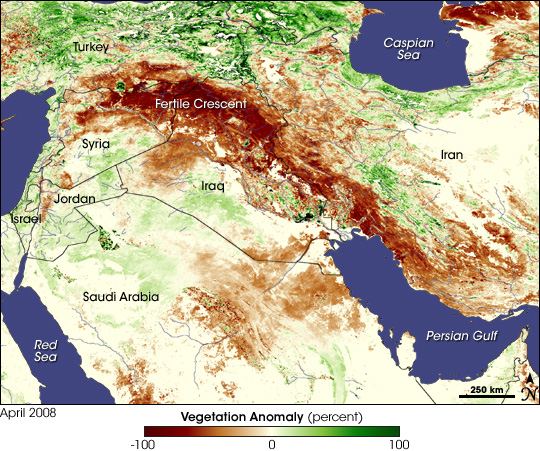
Drought in the Fertile Crescent
From NASA, a satellite photo showing drought in the Fertile Crescent in 2008.

In Parashat Lekh Lekha, Abram is instructed by God to leave his home in what is today Iraq and venture all the way to the other end of the Fertile Crescent to what is today Israel. The Torah tells us neither why Abram was chosen, nor why the destination is Israel; Abram himself does not even seem to know where he is going or why.

But there is no question that Abram's journey is a spiritual one, a quest for holiness that takes him out of his ordinary environment to someplace new, a place where he will be set apart. As the father of monotheism and of two sons from whom Muslims, Christians and Jews see themselves as being descended (at least theologically, if not genetically), Abram is himself becoming holy and creating a new way for all who follow to seek holiness. He is a pioneer of sanctification, one who exemplifies the pursuit of distinctiveness that marks the Abrahamic faiths by taking the extreme path of physical relocation to balance his internal journey.

Fortunately, we do not have to pick up and move to seek holiness. In Judaism, sometimes the act of differentiation that makes us holy is as simple as picking up a book. Now go and learn it.

Shabbat shalom!


~
Rabbi Seth Adelson


Friday, October 19, 2012

Rainbows and Remorse - A Kavvanah for Shabbat Noah

One of the most appealing berakhot / blessings in the Jewish liturgical canon is the one that is recited upon seeing a rainbow:
בָּרוּךְ אַתָּה ה' אֱ-לֹהֵינוּ מֶלֶךְ הָעוֹלָם, זוֹכֵר הַבְּרִית וְנֶאֱמַן בִּבְרִיתוֹ וְקַיָּם בְּמַאֲמָרוֹ
Praised are You, Lord our God, Ruler of the universe, who remembers and is faithful to His covenant and maintains His word.
The covenant to which this berakhah refers is the one that God makes with Noah in the wake of the flood in this week's parashah / Torah reading. The symbol of this covenant is the rainbow (Genesis 9:13), and as such, whenever we see a rainbow we recall God's promise never again to destroy all the living things on Earth.


What is especially striking about this covenant is that God realized that the flood has been a mistake, that the destruction wrought had been in vain, because humans (in particular) were quite likely to transgress again, and as if to prove God's point, Noah does so almost immediately. God expresses regret over the flood in Genesis 8:21:
וַיֹּ֨אמֶר יְהוָ֜ה אֶל־לִבּ֗וֹ לֹֽא־אֹ֠סִף לְקַלֵּ֨ל ע֤וֹד אֶת־הָֽאֲדָמָה֙ בַּֽעֲב֣וּר הָֽאָדָ֔ם כִּ֠י יֵ֣צֶר לֵ֧ב הָֽאָדָ֛ם רַ֖ע מִנְּעֻרָ֑יו וְלֹֽא־אֹסִ֥ף ע֛וֹד לְהַכּ֥וֹת אֶת־כָּל־חַ֖י כַּֽאֲשֶׁ֥ר עָשִֽׂיתִי׃ 
God said to Himself: "Never again will I doom the earth because of man, since the devisings of man's mind are evil from his youth; nor will I ever again destroy every living being, as I have done."
Leaving aside the question over "evil from his youth," about which much of rabbinic tradition disagrees, the essence is clear: God felt remorse, and learned from what might be called a mistake. 

Just like God, we learn from our mistakes as well. We change, we grow, we mature. The rainbow (and its berakhah) therefore remind us not only of the covenant, but also our ability to transcend errors of the past and improve ourselves.


~
Rabbi Seth Adelson

Friday, October 12, 2012

Finding Yourself in the Torah's Holes - Bereshit 5773


This Shabbat marks the absolute completion of the intense cycle of holidays that began with Rosh Hashanah, almost one month ago.  We have welcomed a new year, 5773; we have repented for our transgressions and sought forgiveness from God and from others around us; we have celebrated the unadulterated joy of Sukkot and all of the ritual symbols that go with it; we have mourned those who have passed from this world on Shemini Atzeret, we have danced with the Torah in soaring jubilation as we finished reading one complete cycle of the Pentateuch, the Five Books of Moses.

And on this Shabbat we begin that cycle again with the reading of the first of fifty-four parashiyyot / weekly portions into which the Torah is divided.  This is Shabbat Bereshit, the Shabbat of Creation, and today’s parashah is filled to overflowing with precious gems. On this Shabbat we commemorate not only the creation of the world, but also the creation of the principle of Shabbat itself, arguably the most important feature of human existence that the Jews gave to the world: the weekly vacation day that allows all of us to recharge.

But what I think is most wonderful about Parashat Bereshit is not the two tales of Creation: the orderly seven-day epic of God’s fashioning each piece of the universe or the Garden of Eden story.  It is not the Torah’s attempt to answer the most primal philosophical Big Questions -- where we came from and how.  It is not the beginning of humankind or even the question of Homo sapiens sapiens’ apparent dominion over all of the Earth (Gen. 1:28) vs. our obligation “to till and to tend” the Earth (Genesis 2:15).  

No.  What is truly the most wonderful feature of this parashah is the preponderance of holes found within it.  The Torah’s opening stories are far from airtight; they are riddled with openings.

(When I was an undergraduate, I fulfilled my required semesters of phys. ed. by learning Tae Kwon Do.  This Korean martial art involves many kicks, and requires much flexibility in the legs, and we performed a lot of painful stretches.  I’m just not that flexible.  So one day, I’m trying valiantly to keep my left leg straight against the gym floor while stretching out over my right leg, when the Korean taskmaster -- I mean, teacher -- swipes his hand underneath my left leg, where there are several inches of clearance, and says, “Look at this!  You could drive a truck through there!” Those are the kinds of holes we have in Bereshit.)
black hole
But here, in the Torah, that’s a great thing.  One could make the point, by the way, that all of Judaism is fashioned from the openings in the text of the Torah (I’ll give examples in a moment).  The entire enterprise of rabbinic Judaism, the intellectual give-and-take that emerged in the centuries following the destruction of the Second Temple by the Romans in 70 CE, is based on disagreement over points of ambiguity found in the Torah.  

The first verse of the Torah is (Genesis 1:1, Etz Hayim p. 3):
בְּרֵאשִׁ֖ית בָּרָ֣א אֱלֹהִ֑ים אֵ֥ת הַשָּׁמַ֖יִם וְאֵ֥ת הָאָֽרֶץ׃
Bereshit bara Elohim et hashamayim ve-et ha-aretz.

Rashi, Rabbi Shlomo Yitzhaqi, the great 11th-century French commentator and democratizer of the Torah, is awestruck at the mystery and power behind these opening words.  
אין המקרא הזה אומר אלא דרשיני
Ein hamiqra hazeh omer ela “Darsheini!”  
This text only says, “Explain me!”  

It is calling out to us from the pre-Creation tohu vavohu, the concealed, chaotic mists of pre-history, beckoning to us to interpret.  So says Rashi.

You see, bereshit bara Elohim makes no sense!  It is grammatically incorrect.  It does not mean (as we have come to hear it courtesy of King James), “In the beginning, God created heaven and earth.”  Rather, it means, “In the beginning of [fill in the] BLANK, God created heaven and earth.”  Or maybe it means, “In the beginning of God’s creation of heaven and earth....” Or maybe (as it says in our humash), “When God began to create heaven and earth...”  Or something else entirely that we’re simply not expecting.

There is something missing.  And that missing word, or phrase, or concept, is where all the action is.  That is where we find ourselves reflected in the text.  We can drive whole fleets of trucks through that hole.  It is a vacancy that will never be filled, an opening that can accommodate any idea that you can fit.  The mystery remains permanently enshrined in the first three words of Genesis.

Here is another example.  Some time later, after Eve and Adam are exiled from the Garden, their sons Cain and Abel squabble over who is favored by God.  As I am sure that you know, Cain kills his brother Abel in cold blood.  But just prior to the invention of fratricide, Cain says something to his brother, something which does not appear in the Torah (Gen 4:8, Etz Hayim p. 26):
וַיֹּ֥אמֶר קַ֖יִן אֶל־הֶ֣בֶל אָחִ֑יו וַֽיְהִי֙ בִּֽהְיוֹתָ֣ם בַּשָּׂדֶ֔ה וַיָּ֥קָם קַ֛יִן אֶל־הֶ֥בֶל אָחִ֖יו וַיַּֽהַרְגֵֽהוּ׃
Cain said to his brother Abel, "BLANK."  And when they were in the field, Cain set upon his brother Abel and killed him.

What could he possibly have said? “Abel, there’s something I’ve been meaning to tell you.” or “You know, I’d be much happier if I were an only child.”  Or maybe, “Hey, bro.  Your shoe’s untied!“  The 3rd-century BCE Greek translation known as the Septuagint actually has a line here that the Torah does not -- Cain says, “Come, let us go into the field.”

The Septuagint notwithstanding, there are many possibilities here, and not a single one of them is wrong.  We can imagine many things that Cain might have said just prior to murdering his brother - venting his spleen, or confessing his jealousy and love and pain, or even asking his brother for forgiveness for what he has long been planning to do.

That’s where you come in.  The Torah is not complete without us.  While it would not be accurate to say that the Torah is a blank canvas upon which we can paint whatever we want, it is certainly not true that the words of the Torah alone give us a clear, fixed, immutable message.  The very essence of Judaism, in fact, throughout history has been the interpretation of the words of Torah by us.  By humans.  Because what we received from God, the scroll of parchment that we read from every Shabbat and Monday and Thursday, is in many ways just a sketch.

There is a well-known Talmudic story (BT Menahot 29b) about how when Moses went up on Mt. Sinai to receive the Torah, and he finds God putting little crowns on some of the letters.  Moses asks God, “Ribbono shel olam, Master of the universe, what are you doing?”

God replies, “More than a thousand years from now, a scholar named Rabbi Akiva is going to infer many things from these crowns.”

Moses asks, “Can I see this guy?”

God says, “Turn around.”  So Moses does, and he is instantly transported into the classroom of Rabbi Akiva in Palestine in the early 2nd century, CE.  Moses is sitting in the back behind eight rows of students, and he is listening to Rabbi Akiva interpret the very words of Torah that Moses himself had transcribed.  But he can’t understand any of what Rabbi Akiva is saying, and he starts to feel queasy.

One of the students asks, “Rabbi, where did you learn all of this?”

Rabbi Akiva says, “It was given to Moses on Mt. Sinai!”  And Moses feels much better.

He is relieved because he understands that those parts of the Torah that Moses himself cannot understand will eventually be interpreted by us. The crowns, which are meaningless to Moses, are explained by Rabbi Akiva, and Moses sees then that everything in the written text is subject to later human analysis.  Now of course, nobody alive today can interpret the Torah with the authority of Rabbi Akiva.  But on some level, each of us is obligated to personalize our relationship with God, the Torah, and Israel, to fill in those holes and seek meaning from not just the letters and words themselves, but crowns and the spaces in-between.

Many of us personalized the sukkot in which we dined and welcomed guests last week.  I hope that your Pesah seder includes discussion about how we each identify with the Exodus story and the lessons that we draw today from seeing ourselves as having personally come forth from Egypt.  And each of us, when we hear the Torah read in the synagogue or study it in another context, should strive to connect with the words in a way that is meaningful for us.

But this idea goes far beyond the ritual aspects of Judaism.  The Torah urges us to take care of the needy in our neighborhood, and it is up to us to figure out how to do so.  The Torah requires us to honor our parents, and we each find our way through the depth and complexity of these relationships.  The Torah tells us to teach our children about our tradition, and each of us makes judgment calls about what we teach and how we teach and whom we task with assisting us in doing so.  The Torah instructs us to treat our customers and vendors fairly, and the burden is on us to make sure that we find the right way to do so.

What is missing from the Torah?  You.  Each one of us.


~
Rabbi Seth Adelson


(Originally delivered at Temple Israel of Great Neck, Shabbat morning, October 13, 2012.)


Friday, October 5, 2012

Shabbat Hol Hamo’ed Sukkot 5773: Editing God, Editing Ourselves


For better or worse, I am a natural editor.  I tend to find typographical errors - they jump out at me whenever I come across them in newspapers or books (or love letters / emails from my wife), and it makes it difficult for me to concentrate on the subject at hand. (Of course, as I am posting this on a blog for all to see, I'm now hoping that there are no embarrassing typos.)

Traditionally speaking, Judaism has never accepted the idea that there are errors in the Torah.  The Torah is not a newspaper or a printed book.  During my years of critical study of the Hebrew Bible at the Jewish Theological Seminary, I learned a different approach, but in general, the rabbinic method has been to assume that the text of the Torah is infallible.  

 
The traditional line of thinking is thus: those things that we might see in the text of the Torah that look like errors -- garbled words, or inconsistent language, or things that seem to be missing -- are deliberate, put there during the holy transmission process from God to Moses on Mt. Sinai.  Incomprehensible or seemingly “mis-spelled” words are not incomprehensible to God; they are, rather, a challenge to us to understand them, to try to figure out what exactly was meant.  It’s all part of the large intellectual puzzle that we are meant to solve as we engage in the mitzvah of talmud torah, learning the ideas and concepts of our tradition.  (I spoke about this over the High Holidays as being one of the three essential reasons to be Jewish.)

Tefillah / prayer, however, is an entirely human enterprise.  God wrote the Torah, but we wrote the siddur.  With the exception of those passages that are directly quoted from the Tanakh, like the three paragraphs of the Shema or the Psalms, there is consensus that all of the tefillot in our siddur / prayerbook were written by people.  Yes, the words of tefillah are borrowed from the Tanakh, but they are re-arranged and transmogrified to suit the needs of the composer.  Much of the time the phrases in the siddur deliberately call to mind passages in the Torah to which they relate.

But sometimes, the phrases in the siddur consciously edit the text.  Sometimes, our tradition deliberately mis-quotes the words of the Torah.  And a particularly well-known example appeared in today’s reading.  It’s a text that is surely familiar to everybody here, but I’d like us all to take a look at it right now.  It’s in your humash (Etz Hayim) on page 541, verses 6 and 7:

וַיַּֽעֲבֹ֨ר יְהוָ֥ה ׀ עַל־פָּנָיו֮ וַיִּקְרָא֒ יְהוָ֣ה ׀ יְהוָ֔ה אֵ֥ל רַח֖וּם וְחַנּ֑וּן אֶ֥רֶךְ אַפַּ֖יִם וְרַב־חֶ֥סֶד וֶֽאֱמֶֽת׃
נֹצֵ֥ר חֶ֨סֶד֙ לָֽאֲלָפִ֔ים נֹשֵׂ֥א עָו֛‍ֹן וָפֶ֖שַׁע וְחַטָּאָ֑ה וְנַקֵּה֙ לֹ֣א יְנַקֶּ֔ה פֹּקֵ֣ד ׀ עֲו֣‍ֹן אָב֗וֹת עַל־בָּנִים֙ וְעַל־בְּנֵ֣י בָנִ֔ים עַל־שִׁלֵּשִׁ֖ים וְעַל־רִבֵּעִֽים׃ 
The Lord passed before [Moses] and proclaimed: “The Lord! The Lord! a God compassionate and gracious, slow to anger, abounding in kindness and faithfulness, extending kindness to the thousandth generation, forgiving iniquity, transgression, and sin; yet He does not remit all punishment, but visits the iniquity of parents upon children and children’s children, upon the third and fourth generations.”
(Ex. 34:6-7)
Reading from the Torah, does that sound correct?  Not exactly what we expected, right?  We said this passage (well, most of it) over and over on the Yamim Nora’im, the High Holidays, and that end of what we just read seems to take a sudden about-face.  Holding the children and grandchildren responsible for the sins of the parents?  This seems curious, particularly following that long list of positive attributes.

Over the course of the holiday season, we hear this passage recited over and over in our liturgy.  It is known as the “shelosh esreh middot,” the Thirteen Attributes of God.  We chant it three times when we take the Torah out on festival weekday mornings, and over the course of Yom Kippur we chanted it perhaps as many as fifteen times over the course of the day, repeating it a couple of times during the Selihot prayers appended to every Amidah.  It’s also read from the Torah on minor fast days, like the 17th of Tammuz and Tzom Gedaliah, and the congregation chants this passage aloud before the ba’al qeri’ah, the Torah reader does so.

But in each of those cases, we cut it off after the word “venaqqeh,” which seems to mean, “God cleanses us of our sin.”  The difficulty is that in doing so, we not only cut off in mid-phrase, but we actually make that final attribute mean the opposite of what it says in the Torah.  It’s kind of like if I were interviewed by a journalist about traditional Ashkenazi cuisine, and, when questioned about chopped liver (which, although my family members enthusiastically urged me to taste over and over throughout my childhood, I never learned to appreciate), I said, “I must confess that I do not love chopped liver.”  And when the article about Rabbi Adelson’s favorite Jewish holiday foods comes out, I am quoted as saying, “I must confess that I... love chopped liver!”  That is the extent to which we modify this quote.

Let’s take a closer look.  

First the Hebrew.  Look at p. 541, three lines up from the bottom of the Hebrew.  On the word, “venaqqeh,” you’ll see a ta’am, a trope mark, known as a pashta (it looks like a slightly-curved hook extending up from the upper-left corner of the heh).  Anybody who knows anything about trope knows that the pashta (although it is a slightly disjunctive trope) connects that word with the words that follow it; it makes a musical phrase out of “venaqqeh lo yenaqqeh.”  To cut off after the pashta makes no sense.  (Trope is, by the way, the most basic form of Torah commentary.)

Grammatically speaking, those three words together (“venaqqeh lo yenaqqeh”) are a unit.  It is called an infinitive absolute, where the infinitive form appears first, and then an imperfect form follows.  Naqqeh is the infinitive, and yenaqqeh is the imperfect.  Taken together, naqqeh yenaqqeh would mean, “God shall surely cleanse.”  (Many of us are familiar with a similar structure in the opening of the second paragraph of the Shema: “Vehayah im shamoa tishme’u el mitzvotai” - “If you shall surely heed my mitzvot...”  But the “lo” in our case makes it mean precisely the opposite: “God shall surely NOT cleanse.”  

Now, the ancient commentators looked at the list of Thirteen Attributes, and saw that the first twelve are positive (God is compassionate, gracious, slow to anger, etc.) and then at Number Thirteen, and figured that something is wrong here.  They tried to explain this away by doing the grammatically impermissible: by splitting the infinitive absolute into two words: naqqeh, God cleanses, and lo yenaqqeh, God does not cleanse.  There is an opinion in the Talmud (Yoma 86a) that this means that God cleanses those who return, who seek teshuvah / repentance, and God does not cleanse those who do not return.  

The medieval commentators follow the Talmudic example by softening the blow in other ways: Rashi tells us this means that the punishment described is meted out a little bit at a time, rather than all at once.  Ibn Ezra tells us that even for those of us who repent, we are never entirely cleansed of our sins.

The translation in our humash, the New Jewish Publication Society translation (NJPS) actually pulls a punch here.  It translates “venaqqeh lo yenaqqeh” as “yet He does not remit all punishment.”  This is an attempt to incorporate the ideas of the commentators - that the Torah is not telling us that God surely does not cleanse, but rather that God does not always entirely forgive.

All of this indicates clearly that nobody agrees with the plain meaning of the text, that this line is actually calling out to be edited.  And that is exactly what we do.  

Take a look at what it says in our siddur, in the middle of p. 140.  This is what we chanted three times on Monday and Tuesday morning when we took out the Torah on the first two days of Sukkot, and we’ll do the same for Shemini Atzeret and Simhat Torah in a few days.  The Thirteen Attributes are cut off in the middle of that infinitive absolute: venaqqeh.  Says the translation, “and granting pardon.”  End of story.

There is an essential message here: that we have edited God.  That when we invoke God’s name, we call out to the God of compassion, of grace, and of pardon, not the God of punishment, of vengeance, of retribution.  Our God is the one that cleanses us of our sins, not the one that makes our great-grandchildren suffer on our behalf.

And you know what?  That is exactly how it should be.  

We create our relationship to the Divine:  Each one of us understands our Creator through the prism of own experience.  We use our traditional texts to help understand what we cannot perceive directly through tangible evidence, and we each fashion our own framework through which we relate to God.  

I relate much better to the God that heals the sick and comforts the bereaved than the God that rewards the good and punishes the wicked.  And, since clear evidence of any of those things is hard to come by, I relate even better to the God that maintains the laws of physics and thermodynamics and sustains us with billions of tiny, molecular miracles every instant.

But I don’t want to tell you what to believe.  Your relationship with God is yours.  And if the God that is presented in the Torah works for you, then go with that.  If not, then you are allowed to edit.  We edit our tefillot so that they suit our understanding of God as forgiving; we have the option to edit even further.    

And you know what?  That God -- the compassionate God, the God of little miracles, the God who heals the sick -- that’s the God that we want to emulate.  Just as we edit God, qal vahomer, all the moreso, can we edit ourselves.  We can dedicate more of our energy to be loving, forgiving, caring, to bringing tiny moments of joy and miraculousness into all others who are around us.  

This entire week has been dedicated to the unbridled joy of Sukkot, to the notion that in the wake of achieving forgiveness for our sins, we can celebrate unabashedly this festival of welcoming guests and of fashionable sukkah dinner parties.  It is a time that we can recall not the stern countenance of the God of judgment, but the soft features of the God that wants us to live lives that are satisfying, upright, and beneficial to all.

Shabbat shalom.  Mo’adim lesimhah!


~
Rabbi Seth Adelson
(Originally delivered at Temple Israel of Great Neck, Shabbat morning, October 6, 2012.)

Sunday, September 30, 2012

Uncovering the Meaning of Sekhakh -- Sukkot 5773


In the past week or so, I’ve been thinking quite a bit, as you might imagine, about sukkah construction - what makes it a sukkah, what makes it kosher, what makes it acceptable for fulfilling the mitzvah of “leshev basukkah,” dwelling in the sukkah, one of the principle mitzvot unique to the festival of Sukkot.  Curiously, all of the relevant literature explained the textual basis for the halakhic specifications for the sukkah, but nowhere could I find good reasons for the intent behind said halakhah.  There is a lot of “what” and “how”, but not so much “why”.  (Not that this is so unusual in Judaism, but I have found that the “why” is a much more powerful motivator than the “how.”)

Specifically, I was looking for something about the roof of the sukkah.  You may know that the covering, known in Hebrew as sekhakh (a word which comes from the same shoresh / root as sukkah) must be made from materials that grow from the ground, but why?  I checked many, many sources, and could not find anything so satisfactory.
 

We’re going to take a look at some of those sources for a bit, and then I would like to propose a reason for it -- that is, a reason beyond, “because it says so in the Talmud.”  
 

****

Here are the traditional sources, with one modern one.  Sorry for not putting up all the Hebrew -- I ran out of time before Yom Tov.  Skip to the bottom to see the conclusions.

1.  Genesis 2:6
וְאֵד, יַעֲלֶה מִן-הָאָרֶץ, וְהִשְׁקָה, אֶת-כָּל-פְּנֵי הָאֲדָמָה.
...but a mist would well up from the ground and water the whole surface of the earth.

2.  Leviticus 23:43

...in order that future generations may know that I [God] made the Israelite people live in sukkot when I brought them out of the land of Egypt; I am the Lord your God.

3.  Deuteronomy 16:13

You shall hold the Festival of Sukkot for seven days, at the ingathering from your threshing and your wine-press.

4.  Nehemiah 8:14-15 (6th century BCE)

They found written in the Teaching [Torah] that the Lord had commanded Moses that the Israelites must dwell in booths during the festival of the seventh month, and that they must announce and proclaim throughout all their towns and Jerusalem as follows: “Go out to the mountains and bring leafy branches of olive trees, pine trees, myrtles, palms and [other] leafy trees to make booths, as it is written.”

5.  Mishnah Sukkah 1:4 (2nd century CE)

If one trained over [the sukkah] a vine or a gourd or an ivy and covered it over [with sekhakh], it is invalid.  But if the sekhakh were more than these, or they were cut, it is valid.
This is the general principle: Whatever is susceptible to ritual impurity and does not grow from the earth may not be used to cover the sukkah; but whatever is not susceptible to ritual impurity and grows from the earth may be used as sekhakh.

6.  Babylonian Talmud, Massekhet Sukkah 11b (5th century CE)

THIS IS THE GENERAL RULE: WHATEVER IS SUSCEPTIBLE TO RITUAL IMPURITY etc. How do we know this? Resh Lakish said: Scripture says, “But there went up a mist from the earth” (Gen. 2:6); just as a mist is a thing that is not susceptible to ritual impurity and originates from the soil, so must the sekhakh be a thing that is not susceptible to ritual impurity, and grow from the soil. That is satisfactory according to the authority who says that [the booths of the wilderness were] clouds of glory... For it has been taught: “‘For I made the children of Israel to dwell in Sukkot’ (Lev. 23:43). These were clouds of glory, so says R. Eliezer.” ...

7.  Maimonides, Mishneh Torah, Hilkhot Shofar veSukkah veLulav 5:1 (12th century CE)

The sekhakh may not be appropriate if made from any item.  One may only cover the sukkah with those things that have grown from the earth and that have been uprooted from the earth, and that are not susceptible to uncleanness, and that have no bad odor and do not shed and are not always wilting.

8.  Rabbi Menachem Mendel Schneerson, from Chabad.org (20th century CE)
 
The primary halakhic element of the sukkah is the sekhakh covering, made of branches. The covering takes on the holiness of the sukkah, and even after the holiday ends, it is forbidden to use the sekhakh for any mundane purpose. The sekhakh thus represents the act of transforming a physical part of the universe into something holy, from which the sacredness does not depart. This is the entire purpose of the Holy Temple, to take elements of the physical world and make them into an everlasting dwelling for God.

****
Sukkot is a holiday that directly follows Yom Kippur, just after having (ideally) achieved our repentance from all that we have done wrong in the past year, our having been cleansed of our sins.  There is a sense of rebirth that surrounds Sukkot.  We call it “zeman simhateinu,” the time of our happiness.  This is a festival of pure, unadulterated joy in the wake of the hard work that we put into seeking teshuvah just a few days earlier.  It’s kind of like the calm, self-satisfied feeling that you get after working out.

 
And then, rather than rest, we move out into these temporary huts.  What’s the message?
The sekhakh enables us to see the stars, and to let the sun and the rain through.  It does not separate us out from the natural world, from God’s creation; rather, spending time in the sukkah connects us to nature and to Avinu Shebashamayim, to our God in heaven. The sekhakh is not so much a roof, but a kind of active filter, enhancing our limited connection with the sky.  But there is even more here.
 

The sekhakh must be cut (i.e. dead) things that were once connected to the ground.  Many of you know that I am a gardener and an advocate of getting in touch with God through gardening, and what comes with that is a (curiously enough) a love of compost.  Compost is emblematic of the cycle of life: plants grow and flourish, taking nutrients from the soil; then they die, they decompose, and they provide more nutrients for subsequent generations.  
 
(By the way, there are hints of this in Jewish text as well, related to our own cycle of life.  Of our beloved departed we say, “Tehi nishmato tzerurah bitzror hahayyim” - may his soul be bound up in the bond of life.  What is tzeror hahayyim / the bond of life?  It is that which connects this cycle of life to the next, and repeats again.  Those who have passed on continue to nourish the living.)
 

The sekhakh is the part of the sukkah that connects us to the heavens, the sun and rain.  Since all the materials in the roof are compostable, this amalgam of rain, sun, and nutrients (those produced by decomposing plants) are all that nourish plants, and therefore animals, and therefore us.  Add to this Rabbi Schneerson’s formulation of the sekhakh as creating a kind of holy vessel.  My proposal is this: it is the combination of these physical and spiritual requirements that give us everything that human life needs.  This is what the sekhakh represents: a tangible metaphor for our physical and spiritual needs.
 

And this is a perfect message for the rebirth of Sukkot.


~
Rabbi Seth Adelson
(Originally delivered / discussed at Temple Israel of Great Neck, second day of Sukkot, Tuesday, Oct. 2, 2012.)